AI Is Changing Jobs — Just Not the Way You Think
For about two years now, there's been one dominant story about AI and work: it's coming for your job. Every few weeks, a new headline, a new "X jobs AI will eliminate by 2030" list, a new round of anxious LinkedIn posts. I've read a lot of them. I've also, admittedly, half-believed a few.
But the more I've looked at what's actually happening inside companies — not the predictions, the current hiring behaviour — the story looks different from the headline version. AI isn't mostly deleting jobs. It's changing what the job is made of.
A marketer today doesn't just need to know marketing. A developer doesn't just need to know how to code. A finance professional doesn't just need to know their way around a spreadsheet. Somewhere in the last two years, "can you work alongside AI tools" quietly became an unstated requirement layered on top of the actual job, in almost every function.
The number that actually surprised me
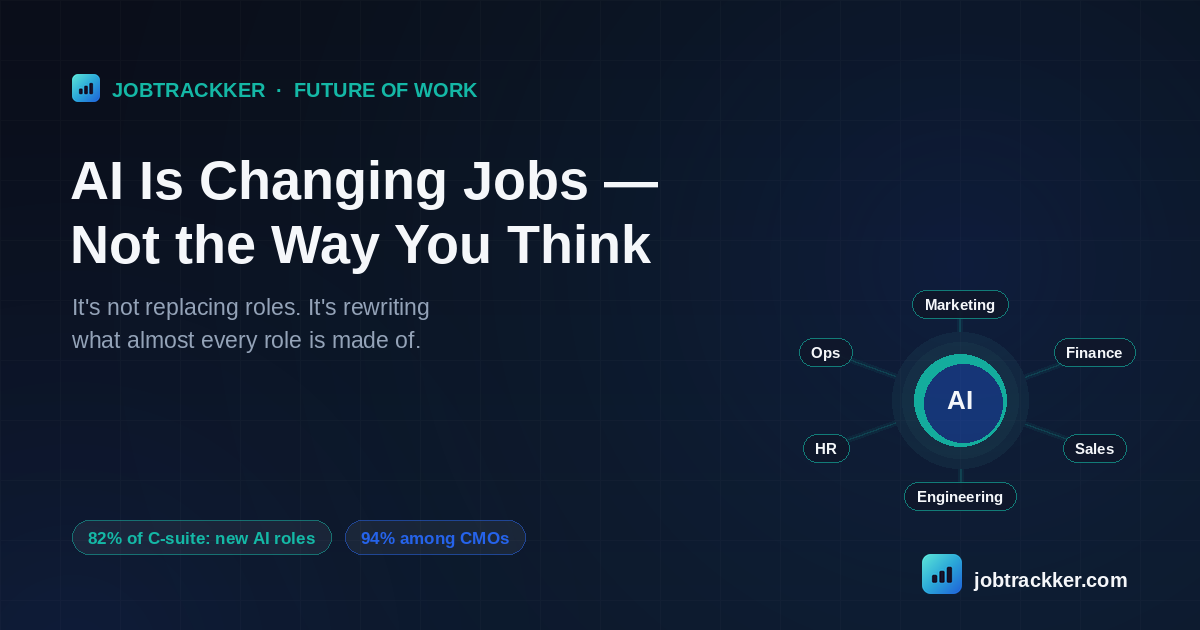
LinkedIn ran a survey this June of 1,252 C-suite leaders across the US, UK, and India. The headline finding: 82% of them say entirely new AI-related roles have shown up inside their organisations since 2022 — titles that plainly didn't exist a few years ago. Forward-deployed engineer. Responsible AI architect. Go-to-market engineer. Roles that sound almost made up until you notice actual people are being hired into them right now.
There's an India-specific version of this too, and it's not a smaller number. A separate LinkedIn report from July found 84% of Indian C-suite leaders saying AI is creating new roles inside their companies — and the breakdown by function is worth sitting with. CMOs led at 94%. CTOs came in at 79%. Marketing leaders, not just engineering ones, are the ones seeing this most.
That's the part that changes the usual framing. This isn't only a story about software engineers being replaced by copilots. It's showing up hardest in marketing.
The honest part nobody puts in the headline
Here's where I'd normally expect the story to wrap up neatly — "AI creates jobs, don't worry" — except the same LinkedIn research has a less comfortable finding sitting right next to the 82%: half of those same executives admit they don't have clear visibility into what skills their organisation will actually need as this keeps playing out. They're creating the roles faster than they can describe them.
Which, if you're the one job hunting rather than the one doing the hiring, is actually useful to know. It means a lot of what looks like a confident, mapped-out "AI strategy" from the outside is, on the inside, still being figured out in real time. Job descriptions for these new hybrid roles are often written by someone who's guessing too. That's not a reason to panic — it's a reason not to assume there's a fixed rulebook you're failing to follow.
Worth a similar caveat on the "skills over degrees" narrative you've probably also seen everywhere. Employers do say this — the vast majority claim they're prioritising skills now. But the actual hiring behaviour behind that claim has moved more slowly than the messaging suggests, in study after study. I'd treat "skills-first hiring" as a real and accelerating direction, not a switch that's already been fully flipped. Same advice either way, though: what you can actually do tends to matter more in a conversation than what your degree says, even if the ATS filters haven't fully caught up yet.
What "role + AI" actually looks like
Going back to LinkedIn's broader work-change research: professionals entering the workforce now are on pace to hold roughly twice as many jobs over a career compared to fifteen years ago. Skill requirements are shifting even for people staying in the exact same title. None of this is really about a wholesale swap of humans for AI — it's decomposition. A role gets broken into its component tasks, some of those tasks get automated or accelerated, and the human part of the job shifts toward the parts AI still can't do well: judgment calls, stakeholder relationships, knowing which output to trust and which to throw out.
Practically, across the functions I've seen this play out in:
- Marketing — less time on first-draft copy and campaign reporting, more time on strategy, positioning calls, and knowing which AI output is actually on-brand versus generic.
- Finance — less manual reconciliation and report-building, more time interpreting what the numbers mean and flagging what a model missed.
- Sales — AI drafts the outreach and summarises the call; the actual relationship-building and reading-the-room part is still entirely human.
- Engineering — a lot more code gets written with AI assistance, which shifts the valuable skill toward reviewing, architecting, and knowing when the AI-generated solution is quietly wrong.
- HR — screening and scheduling get faster; judgment on culture fit and difficult people situations doesn't get automated at all.
- Operations — routine coordination gets absorbed by tools; the job increasingly is deciding what to do when the automated process breaks.
None of these is "AI took the job." They're "the job now assumes you can work with AI as a baseline, the same way it used to quietly assume you could work with Excel or email."
The better question
Going back to where I started — "will AI take my job" isn't really the question worth spending energy on, mostly because nobody, including the executives creating these roles, can answer it with any confidence right now. A more useful pair of questions: which parts of what you currently do is AI already doing faster than you, and what does that free you up to get better at instead?
That second half is the part that's easy to skip. If AI is quietly absorbing the repetitive 60% of your role, the interesting question isn't just "am I safe" — it's what you do with the time that opens up. The people who've figured that out are the ones showing up in the "94% of CMOs say new roles are emerging" number, not the people who spent the last year worrying about the headline instead.
If you're actively job hunting right now, one small practical habit worth building: when you're scoring a role's fit or reading a job description on JobTrackker, pay attention to which of the responsibilities are AI-adjacent even when the title doesn't say so. That's usually a better signal of where a company actually is on this shift than anything in their careers-page copy.
What's your take — is AI creating more roles at your company than it's replacing, or does it feel the other way around from where you're sitting?