96% of Professionals Say They're Open to Switching Jobs — Here's What That Number Actually Means
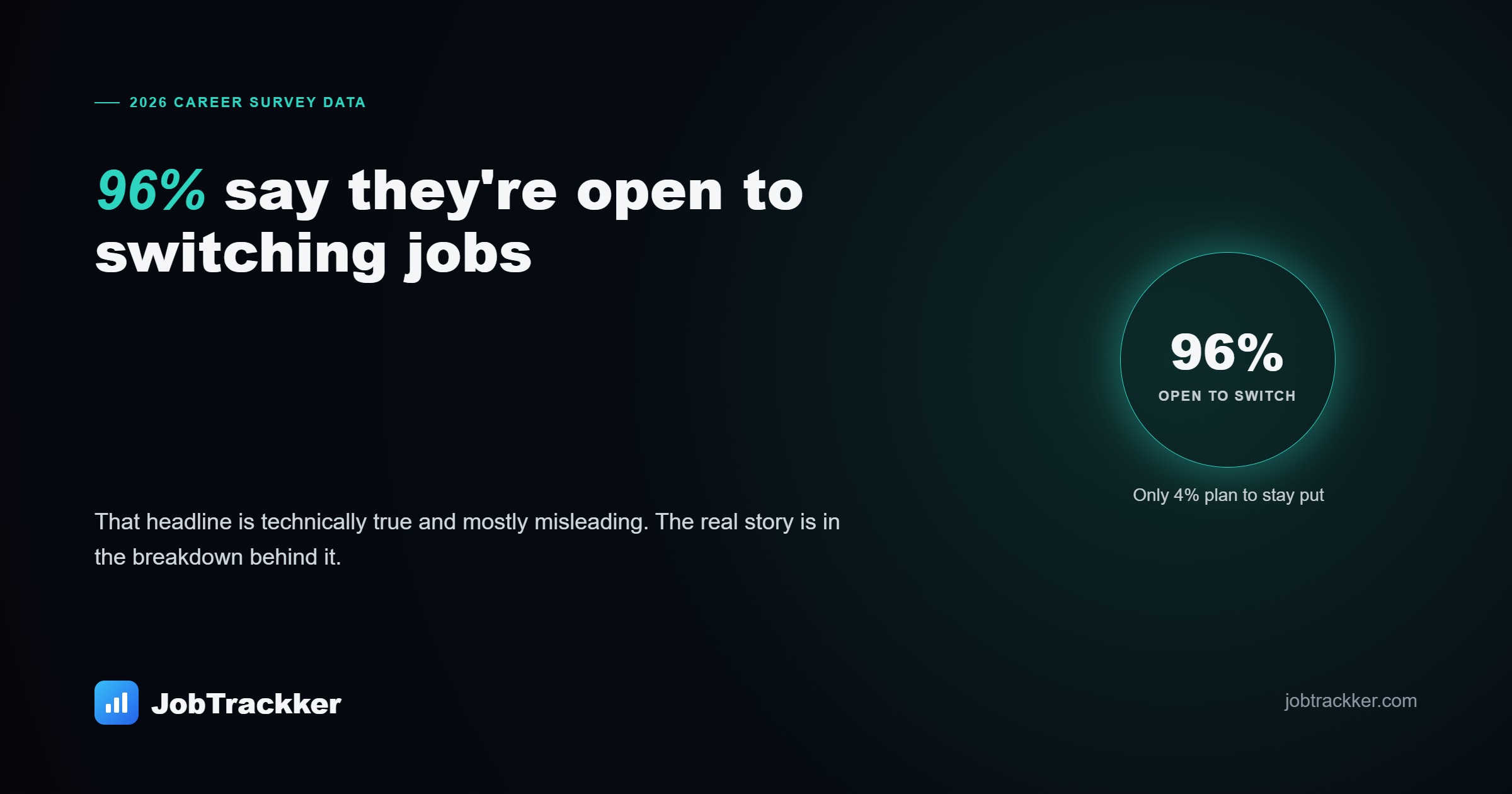
I saw the "96%" number first the way most people probably did — as a headline, stripped of context, designed to make you stop scrolling. It worked. And then I read the actual survey, and the number is real, but the headline version of it is a little misleading.
foundit's Appraisal Survey 2026 asked 2,598 professionals across 15 sectors and locations in India, with fieldwork closing in June this year, whether they were open to switching jobs. 96% said yes in some form. Only 4% said they had no plans to move at all.
That does not mean 96% of India's workforce is about to quit. It means almost nobody is completely closed to the idea of a better offer — which is a different, more interesting claim.
The breakdown matters more than the headline
Here's the actual split behind the 96%:
- 52% are actively looking for a new role right now.
- 34% aren't actively searching but are open to the right opportunity.
- 11% aren't looking at all currently, but would move for the right offer.
- 4% plan to stay put.
Being "open" and being "actively hunting" are not the same behavior, and collapsing them into one headline number erases most of the useful information. Someone in the 34% bucket might be reasonably content and simply willing to take a call from a recruiter. Someone in the 52% bucket has already updated their resume. Treating those as the same signal — which most of the coverage of this survey did — misses the point of the data.
The timing isn't a coincidence
The survey landed right in the middle of appraisal season, and that context explains a lot of the 52%. As of June 2026, 28% of respondents hadn't been appraised yet at all. Among those who had, most increments landed below 10%, and 7.7% got appraised with no increment whatsoever.
That's a fairly ordinary recipe for job searching: wait months for a review, get a single-digit bump or nothing, then have a recruiter reach out the same week with a materially better number. It doesn't take a bad employee or a bad company for that sequence to end in a resignation letter — it just takes ordinary timing working against you.
Money isn't actually the biggest reason
This is the part of the survey I found more useful than the 96% headline. Among people considering a switch, 23% cited better pay elsewhere as their reason — the single largest bucket, but not a majority, and not even close to explaining the whole picture. 20% pointed to a lack of career growth or promotion. 16% said they wanted better learning opportunities. 14% cited work culture or management issues.
Add up everything that isn't pure compensation and it comfortably outweighs pay as the reason people are willing to leave. A raise addresses one of those four reasons. It does nothing for the other three.
The manager number is the one worth sitting with
One stat from the underlying reporting stood out to me more than the headline figure: 32% of professionals said they got little to no meaningful support from their manager during the appraisal process — 22% said no support at all, another 10% said they were largely left to handle it themselves.
That's not really an HR statistic. Whether someone's manager actually advocated for them during review season is one of the more direct levers on whether that person starts looking elsewhere afterward — arguably more direct than the size of the increment itself. A person who got a modest hike but had a manager who fought for them and gave them a clear next step tends to behave very differently from someone who got the same modest hike and heard nothing.
What I'd take from this if I were job hunting
If you're sitting in the 52% or the 34%, the useful question probably isn't "can I get more money elsewhere" — that's usually true almost anywhere. It's closer to: which of the four reasons is actually driving you? Pay, growth, learning, or the relationship with your manager are different problems, and a job switch only fixes the one you're actually leaving for. Chasing a 20% raise into a role with the same lack of growth path just moves the same frustration to a new company with a longer commute.
And if you're not currently looking — the 34% and 11% together are worth noticing too. Being "not actively searching" doesn't mean the market isn't paying attention to you. If your current role has been flat for a while and nobody's had a real conversation with you about what's next, that's worth addressing before you're the one waiting for an appraisal that doesn't move the needle.
Either way, the honest version of this story isn't "everyone wants to quit." It's that very few people are fully closed to a better option — which means the bar for "better" is doing a lot of the actual work, and it's rarely just the salary number.